

1476+
Customer Reviews
24-7 Emergency Service in Philadelphia, Bucks, and Montgomery County


Our 2026 Guide to Ductless Mini Splits vs. Central Air: Which Cooling System Is Right for You?
Published: August 17, 2026Updated: October 10, 2026
Homeowners across Philadelphia, Bucks, and Montgomery County ask us the same question every cooling season: should you install central air or a ductless mini split? This ductless mini split vs central air comparison covers how each system works, what it costs, and how to know which one is right for your house.
At Bill Frusco Plumbing and Heating, we’ve installed and serviced both systems across the region for more than 50 years as a third-generation, family-owned company. Here’s what we tell homeowners before they decide.
Key Takeaways
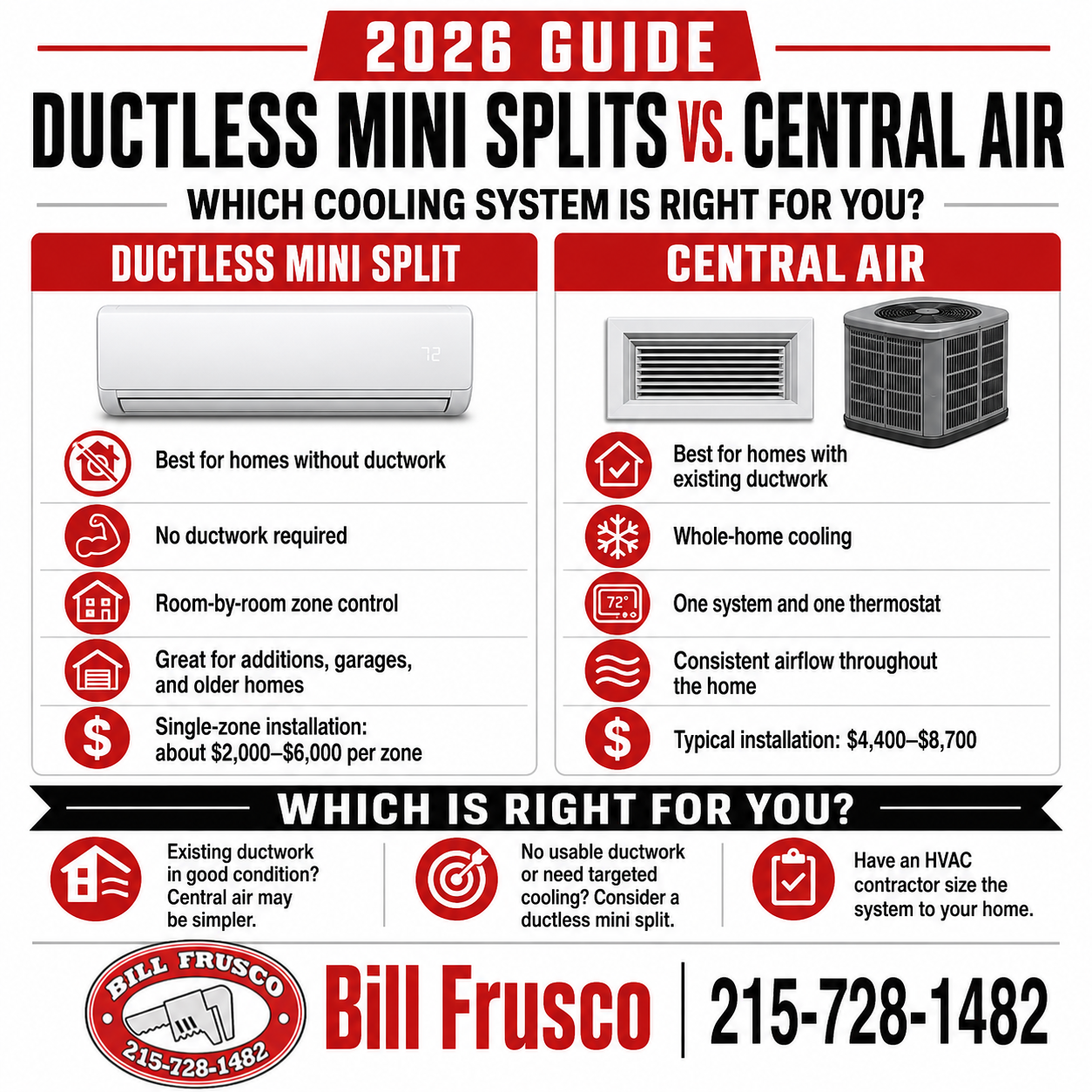
- Central air usually makes more sense for homes with existing ductwork; ductless mini splits are built for homes without it
- Central air installation cost in our service area typically falls between $4,400 and $8,700
- Mini split installation cost depends heavily on zone count, generally starting around $2,000–$6,000 per zone
- Mini splits offer room-by-room zone control that central air cannot match
- Garages, additions, and older homes without ducts are common candidates for a ductless mini split system
- A qualified HVAC contractor should size the system to your home rather than push one option by default
What Is a Ductless Mini Split System?
A ductless mini split system pairs an outdoor compressor with one or more indoor air handlers, mounted on a wall or ceiling in the room being cooled. Refrigerant lines connect the units instead of ductwork, and each indoor unit runs as its own independently controlled zone.
Because there’s no ductwork involved, mini split installation is often the fastest and least invasive path to adding cooling to a room that doesn’t already have it — a garage, a finished attic, a sunroom, or an addition built after the original ductwork was installed.
How Does Central Air Conditioning Work?
Central air conditioning uses an outdoor condenser and compressor connected to an indoor evaporator coil, typically mounted above your furnace or air handler. The blower pulls warm air across the coil, cools it, and pushes it through your home’s existing ductwork to every room on the system.
Since central air relies on ductwork already built into the home, it’s the more straightforward choice when that infrastructure is already in place — one thermostat, one system, whole-home coverage.
Ductless Mini Split vs. Central Air: Key Differences
| Feature | Ductless Mini Split | Central Air |
| Ductwork required | No | Yes |
| Zone control | Room-by-room | Typically whole-home |
| Best for | Additions, garages, homes without ducts | Homes with existing ductwork |
| Installation time | About a day per zone | A day (existing ducts) to several days (new ducts) |
| Typical lifespan | 15–20 years | 15–20 years |
Central Air Installation Cost vs. Mini Split Installation Cost
Cost is usually the deciding factor once homeowners understand how each system works.
| System | Typical Installed Cost | What Drives the Range |
| Central air | $4,400–$8,700 | System size, SEER2 rating, ductwork condition |
| Mini split | $2,000–$6,000+ per zone | Zone count, unit style, home layout |
These are general industry ranges — your exact cost depends on your home’s layout, so Bill Frusco recommends a free estimate rather than relying on national averages.
Central air vs mini split cost, in short: Is ductless AC cheaper than central air? For a single room, a garage, or an addition, yes — a one- or two-zone mini split is usually less expensive than extending ductwork to a space that never had it. For whole-home cooling in a house that already has ductwork, central air is often the more cost-effective route, since you’re not paying for multiple indoor units and outdoor condensers.
Benefits of Ductless Mini Splits
- No ductwork required. Ideal for additions, garages, and older homes where running new ducts isn’t practical
- Room-by-room control. Only cool the rooms you’re using, which can lower energy costs compared to cooling an entire home at once
- Fast installation. Most single-zone jobs are completed in about a day
- Good fit for AC for garages, finished basements, and other spaces central air doesn’t reach
When Central Air Installation Makes More Sense
If your home already has ductwork in good condition, central air installation is usually the simpler and more cost-effective option for whole-home cooling. One system, one thermostat, and consistent airflow to every room — without the visible indoor units a mini split requires in each space. If your existing system is failing, an air conditioning replacement using the same ductwork is often faster and less disruptive than switching to ductless.
Mini Split Replacement: Signs It’s Time
Like any cooling system, ductless equipment doesn’t last forever. Signs that point to mini split replacement rather than another repair include:
- The system is approaching 15 years old
- Refrigerant leaks in an older unit still running R-410A
- Uneven cooling between zones that repairs haven’t resolved
- Rising energy bills without a change in how the system is used
Unlike an air conditioning replacement on a fully ducted system, replacing a mini split often means swapping just the affected zone’s indoor and outdoor units rather than the whole setup.
If you’re weighing repair against replacement on any cooling system, our guide to what causes AC problems during heat waves walks through the same decision points in more detail.
FAQs
Is ductless AC cheaper than central air for a single room or garage?
In most cases, yes. A single-zone system in a garage typically needs just one indoor unit, a compact outdoor condenser, and a short refrigerant line run through the wall — work that’s usually finished in about a day, without opening up your home’s existing ductwork.
How do I choose the right HVAC contractor for a mini split or central air installation?
Look for a licensed, insured HVAC contractor with experience installing both systems, since the right recommendation depends on your home’s ductwork, layout, and budget — not a one-size-fits-all pitch. Ask for a written estimate and references before signing anything.
Does central air conditioning still work if I already have a furnace?
Yes. Central air conditioning is typically installed alongside an existing furnace, sharing the same air handler, blower, and ductwork — only the outdoor condenser and indoor coil are added.
Can a mini split replace a window AC unit permanently?
Yes. A single-zone ductless mini split system cools more effectively and quietly than a window unit, without blocking a window or needing to be removed each fall.
Ready to Compare Your Cooling Options?
Whether it’s a full central air installation or a ductless mini split system for a garage or addition, Bill Frusco Plumbing and Heating has installed both across Philadelphia, Bucks, and Montgomery County since 1967. We offer free estimates, 100% financing, guaranteed workmanship, and 24/7 emergency service. Schedule service online or call us today to find out which system fits your home.